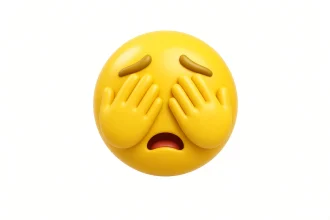

That little 😔 can mean more than simple sadness. The real meaning depends on the message around it.
You get a short “I wish you were here 😔” or “That didn’t work out 😔” and suddenly you wonder what the sender really means. The pensive emoji 😔, officially called Pensive Face, commonly expresses quiet sadness, disappointment, hurt, regret, loneliness, or reflection. It is usually softer than 😭 and often feels more thoughtful than openly dramatic.
😔 is the quiet way of saying, “This one really got to me.”
What Does the Pensive Emoji 😔 Mean?
The official Unicode name for 😔 is Pensive Face. Its downcast eyes, furrowed brows, and small flat mouth give it a subdued emotional appearance.
In everyday messages, 😔 can suggest that someone feels disappointed, hurt, lonely, regretful, or simply stuck in a thoughtful mood. The exact interpretation comes from the surrounding words and relationship.
For example, “I missed the concert 😔” sounds disappointed, while “I miss you 😔” can sound lonely or affectionate. “I should have called you 😔” may communicate regret.
| Emoji | Core meaning | Misread as | Best used when |
| 😔 | Quiet sadness or reflection | Anger | You feel emotionally low |
| 😞 | Disappointment | Tiredness | Something went badly |
| 😟 | Worry | Sadness | You are concerned |
| 😕 | Confusion | Disappointment | Something is unclear |
| 😓 | Stress or difficulty | Simple sadness | You are having a hard time |
| 😥 | Sadness with relief | Ordinary crying | You feel emotional but relieved |
| 😢 | Open sadness | Mild disappointment | You want to show stronger sadness |
| 😭 | Intense crying | Mild sadness | The emotion feels overwhelming |
| ☹️ | Unhappiness | Anger | You are displeased |
| 🙁 | Mild sadness | Serious grief | Something feels slightly wrong |
😔 Pensive Face
Meaning: Quiet sadness, disappointment, reflection, or emotional heaviness.
Example 1: I really miss those days 😔
Example 2: I wish things had gone differently 😔
😞 Disappointed Face
Meaning: Disappointment, sadness, or regret after something goes wrong.
Example 1: I waited all day 😞
Example 2: That was not what I expected 😞
😟 Worried Face
Meaning: Concern, worry, or uneasiness.
Example 1: I hope you are okay 😟
Example 2: I’m worried about tomorrow 😟
😕 Confused Face
Meaning: Uncertainty or confusion about a situation.
Example 1: I don’t understand what happened 😕
Example 2: Why did that happen? 😕
😓 Downcast Face with Sweat
Meaning: Stress, difficulty, or an uncomfortable situation.
Example 1: That test was brutal 😓
Example 2: I have so much work 😓
😥 Sad but Relieved Face
Meaning: Sadness combined with some sense of relief.
Example 1: At least everyone is safe 😥
Example 2: It’s finally over 😥
😢 Crying Face
Meaning: Visible sadness or emotional pain.
Example 1: That really hurt 😢
Example 2: I can’t believe it 😢
😭 Loudly Crying Face
Meaning: Strong crying or overwhelming emotion.
Example 1: I miss you so much 😭
Example 2: That ending was painful 😭
☹️ Frowning Face
Meaning: Unhappiness or a negative reaction.
Example 1: I’m not happy about this ☹️
Example 2: That was unfair ☹️
🙁 Slightly Frowning Face
Meaning: Mild sadness, concern, or dissatisfaction.
Example 1: I hoped for something else 🙁
Example 2: That’s disappointing 🙁
How to Use the Pensive Emoji in Texting
On WhatsApp, 😔 is useful when words alone feel a little too plain. It can soften a message about missing someone, disappointment, regret, or a difficult day.
Examples:
- “I really wanted to see you 😔”
- “Today was not my day 😔”
- “I should have listened to you 😔”
On Instagram, the emoji can work in captions, comments, Stories, or replies. A sad post may use it sincerely, while a funny post can use it dramatically for effect.
On TikTok, context matters even more. A creator or commenter may use 😔 for genuine emotion, exaggerated sadness, relatable humor, or ironic self-pity. The emoji alone cannot tell you which one is intended.
What Does 😔 Mean in a Text?
Usually, it signals some form of emotional heaviness. It might mean “I’m sad,” “I’m disappointed,” “I miss you,” “I regret that,” or simply “That hurts.”
Look at the words before the emoji. “I miss you 😔” and “I lost my charger 😔” obviously carry different emotional weight.
What Does 😔 Mean From Someone You Like?
If someone sends 😔 during an affectionate conversation, it can make the message sound vulnerable or emotionally soft.
For example, “You left so early 😔” could simply express disappointment. In a romantic conversation, however, it might also carry a subtle “I wanted more time with you” feeling.
It is not automatically a flirting emoji. The relationship and surrounding conversation matter more than the emoji itself.
Can 😔 Be Flirty?
Yes, but usually indirectly. Someone might use 😔 to create a playful “you don’t miss me?” or “why did you leave?” tone.
For example:
“You really went home without saying goodbye 😔”
In a romantic conversation, that could sound teasing and affectionate. In another relationship, it might simply be genuine disappointment.
Funny Pensive Emoji Memes and Reactions
The 😔 emoji can also become funny when the situation is intentionally minor.
Someone might write:
- “Me after my Wi-Fi disconnects for 10 seconds 😔”
- “Nobody liked my message 😔”
- “When the last slice of pizza disappears 😔”
- “Me pretending I wasn’t waiting for your reply 😔”
Here, 😔 does not necessarily communicate serious sadness. The humor comes from treating a small problem as if it were emotionally devastating.
That kind of exaggerated reaction is common in online communication, but it should be read from the surrounding joke rather than assumed from the emoji alone.
Best Replies to 😔
Your reply should match the reason behind the emoji.
If they seem genuinely sad:
- “What happened? 😔”
- “Are you okay?”
- “I’m here if you want to talk.”
If they miss you:
- “I miss you too ❤️”
- “We’ll see each other soon.”
- “I wish I could be there.”
If it seems playful:
- “Aww, what happened? 😔😂”
- “Don’t give me that face 😂”
- “Okay, okay, I’ll make it up to you.”
If you’re unsure:
- “Everything okay?”
- “What does that 😔 mean?”
Asking is often better than guessing.
Best Pensive Emoji Combos; Copy & Paste
Romantic
- 😔❤️ — Missing someone with affection
- 😔🥺 — Soft emotional vulnerability
- 😔💔 — Feeling hurt in a relationship
Cute
- 😔🥺 — Gentle, vulnerable reaction
- 😔🙁 — Mildly sad mood
- 😢🥺 — Tender emotional reaction
Flirty
- 😔❤️ — “I wanted you here”
- 😔🥺 — Playful emotional appeal
- 😔😢 — Dramatic “you hurt me” reaction
Missing Someone
- 😔❤️ — Quietly saying you miss someone
- 😔😢 — Stronger expression of missing them
- 😞❤️ — Disappointed that someone is away
Good Night
- 😔😴 — Sad or thoughtful good night
- 😞😴 — Ending a disappointing day
- 😢😴 — Going to sleep while emotional
Pensive Emoji in 2026
There is no reliable universal ranking that proves 😔 is the single “most popular” pensive emoji in 2026. What can be established is that Pensive Face remains part of the current Unicode emoji set, with the identifier U+1F614 and the CLDR short name “pensive face.”
The emoji is still commonly encountered in personal messages, social comments, emotional posts, and reactions. Current references continue to distinguish it from stronger crying faces such as 😢 and 😭.
| Emoji | Common current use | Typical context | Platform |
| 😔 | Quiet sadness | Texts and emotional posts | WhatsApp, Instagram, TikTok |
| 😞 | Disappointment | Reactions and messages | Social media, chats |
| 😢 | Visible sadness | Emotional reactions | Chats and comments |
| 😭 | Strong emotion | Dramatic or emotional reactions | TikTok, Instagram, chats |
Emoji meanings continue to shift through context, humor, and community habits rather than following one fixed rule.
Why Does 😔 Look Different on iPhone and Android?
Emoji designs are created by individual platforms and vendors. The underlying Unicode character can stay the same while the artwork looks different on Apple, Google, Microsoft, Samsung, or inside an app.
For example, platform references show different renderings of Pensive Face across vendors. A visual difference does not automatically mean the emoji has a different meaning.
This is why the same 😔 may look slightly different on an iPhone, Android phone, Windows PC, or Mac.
FAQ
1. What is the most popular pensive emoji?
There is no reliable universal ranking for “the most popular” pensive emoji. Popularity can vary by platform, audience, conversation, and context.
2. What does 😔 mean when someone sends it?
It can express sadness, disappointment, hurt, loneliness, regret, or reflection. Check the surrounding message and relationship before deciding what the sender means.
3. Why do emojis look different on iPhone vs Android?
Different operating systems and vendors use their own emoji artwork and fonts. The underlying Unicode character remains the same even when the design changes.
4. Are pensive emojis used differently in other countries?
Interpretations can vary across languages, communities, relationships, and online settings. It is better to consider the full conversation than assign one meaning to an entire country or culture.
The pensive emoji 😔 works best when you want to communicate a quiet emotional reaction without making the message overly dramatic. Its meaning becomes clearer when paired with natural words and context.
Whether you’re texting, replying to a funny meme, missing someone, or having a romantic conversation, let the situation guide the interpretation.
Conclusion
The pensive emoji 😔 is a simple way to express quiet sadness, disappointment, reflection, or emotional vulnerability.
Its meaning depends on the conversation and relationship. Use it naturally, and always consider the words around the emoji before assuming what someone means.

he PressioHub team is passionate about emojis and the way people use them to express feelings, reactions, ideas, and personality in digital conversations. We create simple, easy-to-understand content about emoji meanings, symbols, combinations, and everyday emoji usage. Whether you are wondering what an emoji means, looking for the right emoji for a message, or exploring new ways to express yourself online, PressioHub is here to help. Our goal is to make emoji-related information clear, useful, and fun. We research meanings and common usage so readers can choose the right emoji with confidence. At PressioHub, we believe that sometimes one emoji can say what words cannot.