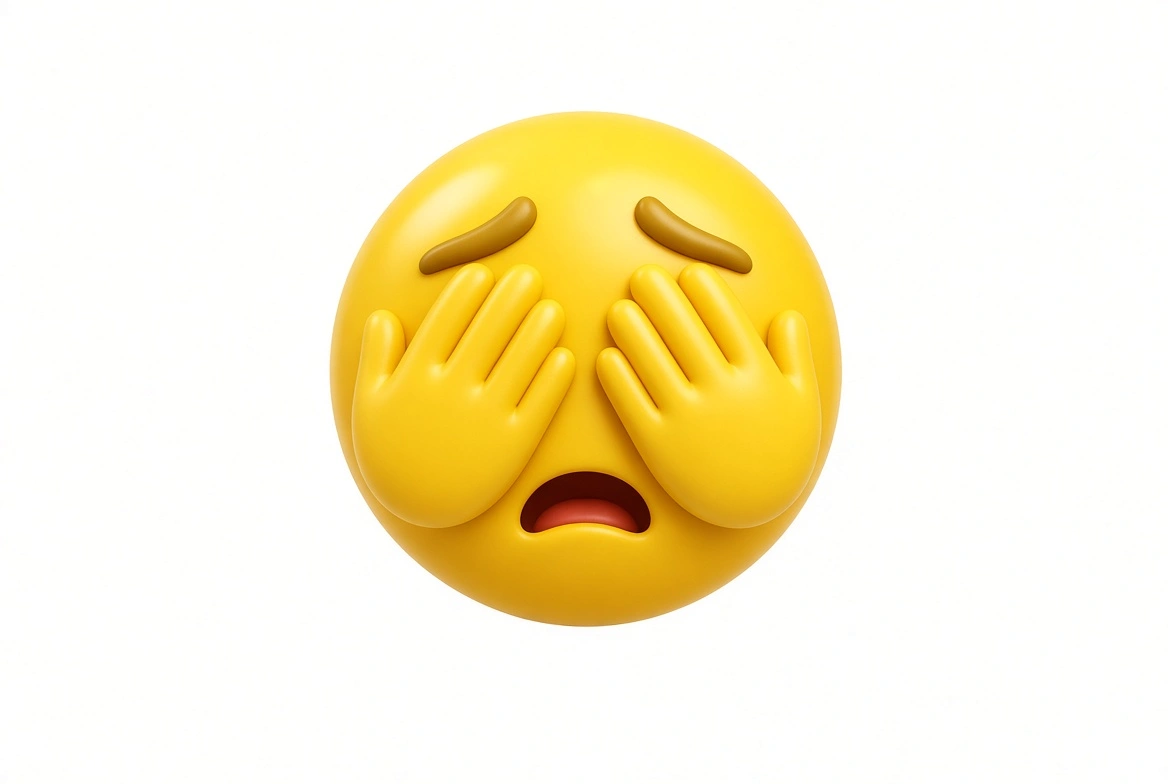
You know that moment when someone compliments you, says something unexpectedly sweet, or catches you looking? You want to hide, but you also want to see what happens next. That is exactly where the shy emoji 🫣 fits.
The official Unicode name is Face with Peeking Eye, and “shy” is one of its Unicode keywords. It can express shyness, embarrassment, awkwardness, nervous curiosity, or the feeling of hiding while still watching. The exact meaning depends on the message and situation.
🫣 is basically the digital version of “I’m shy, but I’m still looking.”
What Does the Shy Emoji 🫣 Mean?
🫣 is the clearest answer when someone searches for a shy emoji. Its design shows a face covering itself while one eye peeks through, creating a mix of hiding and curiosity. Unicode lists keywords including “shy,” “embarrass,” “hide,” “peek,” and “stare.”
In texting, 🫣 can mean “I’m embarrassed,” “You’re making me shy,” “I can’t look,” or “Okay, I’m interested.” It can also be used for secondhand embarrassment when you cannot stop watching an awkward situation.
Its meaning can shift with context. After a compliment, it may feel bashful. After gossip, it can mean “I shouldn’t be watching this, but I am.” During flirting, it can soften a bold or affectionate message.
| Emoji | Core meaning | Misread as | Best used when |
| 🫣 | Shy, embarrassed, peeking | Fear only | You feel bashful or curious |
| 🤭 | Coy laughter or embarrassment | Serious shock | Something feels awkward or funny |
| 😳 | Blushing or strong embarrassment | Fear | You feel caught off guard |
| 😊 | Warm, gentle happiness | Shyness only | You want a friendly soft tone |
| ☺️ | Gentle, modest warmth | Formal politeness | A calm affectionate reply |
Shy Emoji Cards
🫣 Face with Peeking Eye
Meaning: Shyness, embarrassment, hiding, or curiosity while still looking.
Example 1: Stop making me blush 🫣
Example 2: Okay, I’m listening 🫣
🤭 Face with Hand Over Mouth
Meaning: A coy laugh, embarrassed reaction, or playful “oops” feeling.
Example 1: I probably shouldn’t have said that 🤭
Example 2: You caught me 🤭
😳 Flushed Face
Meaning: Blushing, embarrassment, surprise, or feeling suddenly self-conscious.
Example 1: You actually noticed? 😳
Example 2: That compliment surprised me 😳
😊 Smiling Face with Smiling Eyes
Meaning: A warm smile that can feel gentle or bashful in the right context.
Example 1: That’s really sweet 😊
Example 2: Thank you 😊
☺️ Smiling Face
Meaning: A soft smile that can give a message a gentle or affectionate feeling.
Example 1: I’m glad you liked it ☺️
Example 2: That means a lot ☺️
🫢 Face with Open Eyes and Hand Over Mouth
Meaning: Surprise, embarrassment, disbelief, or being caught off guard.
Example 1: Wait, you heard that? 🫢
Example 2: I did not expect that 🫢
😅 Grinning Face with Sweat
Meaning: Nervousness or awkwardness mixed with a smile.
Example 1: I forgot to reply 😅
Example 2: That was awkward 😅
🙈 See-No-Evil Monkey
Meaning: Playfully hiding from something embarrassing, awkward, or difficult to face.
Example 1: I can’t believe I sent that 🙈
Example 2: Don’t make me look 🙈
🥺 Pleading Face
Meaning: A vulnerable or pleading expression that can make a shy request feel softer.
Example 1: Can you stay a little longer? 🥺
Example 2: Please don’t laugh 🥺
🫠 Melting Face
Meaning: Feeling overwhelmed, awkward, embarrassed, or emotionally undone.
Example 1: That was way too sweet 🫠
Example 2: I don’t know what to say 🫠
How to Use the Shy Emoji the Right Way
WhatsApp: 🫣 works well after compliments, teasing, confessions, or awkward moments. For example: “You really think I’m cute? 🫣” sounds more bashful than simply writing the question.
Instagram: It can appear in comments, Stories, captions, and replies. A comment such as “Okayyy, I see you 🫣” can communicate playful interest without making the intention too serious.
TikTok: 🫣 is useful for reaction comments, awkward clips, gossip, crush-related posts, and secondhand embarrassment. It can mean “I’m watching this unfold even though I probably shouldn’t.”
Do:
- Match the emoji to the surrounding message.
- Consider your relationship with the sender.
- Use it naturally after a compliment or playful comment.
- Look at the whole conversation before deciding what it means.
Don’t:
- Assume 🫣 automatically means flirting.
- Assume the sender is definitely embarrassed.
- Overload a message with similar reactions.
- Treat online interpretations as universal.
Shy Emoji Texting, Flirting & Replies
In texting, 🫣 often works as an emotional softener. Someone might write, “Not gonna lie, I missed you 🫣.” The emoji makes the admission feel vulnerable and slightly playful.
In flirting, it can appear after a compliment or bold statement: “You looked really good today 🫣.” That does not automatically prove romantic intent, but it can make the message feel more bashful.
If someone sends “You’re cute 🫣,” a warm reply could be “Look who’s talking 😊.” If you want to keep things playful, “Are you getting shy now? 🤭” matches the tone.
For a neutral reply, try “Haha, that was cute 😊.” If you are unsure about the sender’s intention, respond to the actual words rather than trying to decode the emoji alone.
Funny Shy Emoji Memes
🫣 works particularly well in memes because its visual joke is simple: hiding while still looking. That makes it useful for awkward confessions, gossip, embarrassing screenshots, crushes, and situations where someone says they are not interested but keeps watching.
Common meme-style captions include:
- “Me pretending I didn’t see the message 🫣”
- “I shouldn’t read the comments… 🫣”
- “When your crush likes your old photo 🫣”
- “Me watching the drama after saying I don’t care 🫣”
- “When they finally reply after three hours 🫣”
These are humorous interpretations, not fixed meanings. The same emoji can be serious, playful, romantic, or simply awkward depending on the caption.
Best Shy Emoji Combos: Copy & Paste
Romantic
- 🫣🥰 — shy affection
- 🫣😚 — bashful romantic reply
- 🫣❤️ — shy romantic feeling
Cute
- 🫣😊 — soft and bashful
- 🤭😊 — playful embarrassment
- 🙈☺️ — hiding playfully
Flirty
- 🫣😳 — feeling flustered
- 🫣🥺 — shy and vulnerable
- 🫣😚 — playful affection
Missing Someone
- 🫣🥰 — soft emotional reaction
- 😊🫣 — shy admission
- 🙈🥰 — playful affection
Good Night
- ☺️😚 — gentle good-night message
- 🥰😚 — affectionate good night
- 🫣😚 — shy and playful good night
Trending Shy Emoji in 2026
There is no reliable universal ranking showing that one shy emoji is the most popular across every platform. However, 🫣 remains particularly relevant because Unicode explicitly includes “shy” among its keywords, while current emoji resources document its use for embarrassment, hiding, peeking, and curiosity.
| Emoji | Why trending | Who uses it | Platform |
| 🫣 | Strong visual for awkwardness and shyness | Broad online audiences | TikTok, Instagram, WhatsApp |
| 🤭 | Useful for playful embarrassment | Broad online audiences | Chats and social media |
| 😳 | Immediately communicates blushing | Broad online audiences | Messaging and social media |
| 😊 | Simple warm reaction | Broad online audiences | WhatsApp and Instagram |
Emoji meanings continue to evolve through everyday conversations, memes, comments, and platform-specific habits rather than through one universal rule.
Why Does the Shy Emoji Look Different on iPhone and Android?
The same Unicode emoji can have different artwork on Apple, Google, Microsoft, Samsung, and other platforms. Unicode identifies the underlying character, while each platform can create its own visual design.
That means 🫣 may look slightly different on an iPhone than on Android or Windows. The visual difference does not automatically create a different meaning.
One useful example is 🤭. Its appearance has changed significantly across platforms over time, and Apple’s earlier design was interpreted differently before the introduction of 🫢.
FAQ
1. What is the most popular shy emoji?
There is no dependable worldwide ranking for one universally most-popular shy emoji. 🫣 is the most directly associated with “shy” because Unicode includes that word among its keywords.
2. What does 🫣 mean when someone sends it?
It can mean shyness, embarrassment, curiosity, awkwardness, or “I’m hiding but still looking.” The surrounding message and relationship determine the most likely interpretation.
3. Why do emojis look different on iPhone vs Android?
Different operating systems use their own emoji artwork and fonts. The underlying Unicode character can remain the same even though its visual appearance changes.
4. Are shy emojis used differently in other countries?
Interpretations can vary between languages, communities, platforms, and individuals. It is better to consider the complete conversation than assume one meaning applies everywhere.
The shy emoji 🫣 is useful because it captures a feeling that can be difficult to express with words alone.
Use it naturally for bashful, awkward, curious, or playful moments, and let the surrounding message provide the real context.
Sometimes one little peek says enough.
Conclusion
The shy emoji 🫣 is a simple way to express shyness, embarrassment, curiosity, or a playful reaction. Its meaning depends on the words, situation, and relationship behind the message.
Whether you use it for texting, flirting, funny moments, or a cute reply, keep the context in mind. Sometimes a little peek says more than a long explanation.

he PressioHub team is passionate about emojis and the way people use them to express feelings, reactions, ideas, and personality in digital conversations. We create simple, easy-to-understand content about emoji meanings, symbols, combinations, and everyday emoji usage. Whether you are wondering what an emoji means, looking for the right emoji for a message, or exploring new ways to express yourself online, PressioHub is here to help. Our goal is to make emoji-related information clear, useful, and fun. We research meanings and common usage so readers can choose the right emoji with confidence. At PressioHub, we believe that sometimes one emoji can say what words cannot. 😊