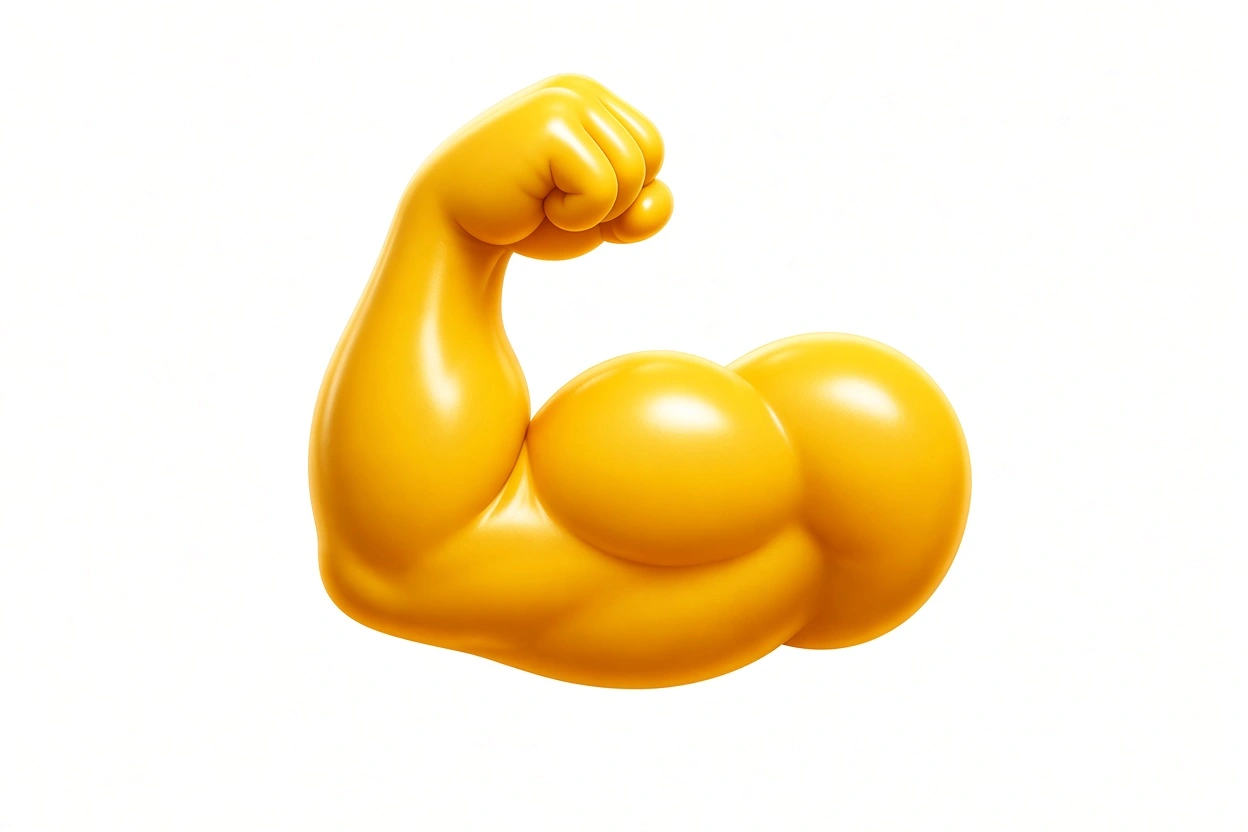
One little 💪 can mean “you’ve got this,” “I’m strong,” or “I’m jokingly surviving.”
When someone searches for the arm emoji, they usually mean 💪, officially called Flexed Biceps. Unicode identifies it as U+1F4AA, while its common uses include strength, exercise, effort, motivation, and support.
In texting, however, 💪 has grown beyond actual muscles. Someone can use it after finishing homework, surviving a difficult day, celebrating a win, or encouraging a friend. The exact tone depends on the message around it.
💪 is less about muscles than the strength you want your message to show.
What Does the Arm Emoji 💪 Mean?
The main arm emoji is 💪 Flexed Biceps. Its literal image shows a flexed arm, but people commonly use it for both physical and symbolic strength. Emojipedia describes it as representing strength, working out, and feats of strength.
Here are the most common interpretations:
| Use | What 💪 can suggest | Example |
| Fitness | Working out or muscle | “Leg day done 💪” |
| Support | Encouragement | “You can do it 💪” |
| Achievement | Pride in finishing something | “Finally passed my exam 💪” |
| Confidence | Feeling strong or capable | “I handled it 💪” |
| Resilience | Getting through difficulty | “Still going 💪” |
| Humor | Pretending a small task was heroic | “I washed the dishes 💪” |
The emoji can also appear with different skin-tone modifiers, from 💪🏻 through 💪🏿. Unicode lists these as modifier sequences for Flexed Biceps.
What Does 💪 Mean in Texting?
In texting, 💪 often works like a short emotional reaction. If a friend says, “I have my interview tomorrow,” replying “You’ve got this 💪” communicates encouragement without needing a long response.
It can also celebrate a small victory:
“I finally cleaned my room 💪”
Here, the emoji is not literally about bodybuilding. It adds a playful feeling of accomplishment.
A single 💪 can also work as a reply to good news. If someone says, “I finished the project,” sending 💪 can mean “Nice,” “Strong work,” or “Keep going,” depending on the conversation.
What Does 💪 Mean From a Girl or Guy?
There is no reliable universal difference between how girls and guys use 💪. The emoji itself does not reveal someone’s gender-specific intention.
Look at the surrounding words instead.
“Good luck tomorrow 💪” usually sounds supportive.
“Okay, show me those gym gains 💪” can sound playful or teasing.
“I’m ready 💪” suggests confidence.
This is more useful than trying to decode the sender based only on whether they are a man or woman.
Is the Arm Emoji 💪 Flirty?
💪 is not automatically a flirting emoji. Its basic meaning is strength, effort, encouragement, or confidence.
It can feel flirty when the surrounding conversation is already playful or romantic. For example:
“Trying to impress you 💪”
or
“Okay, strong one 💪”
In these situations, the words create most of the flirtatious tone. The emoji simply reinforces it.
If someone sends 💪 by itself after a normal message, it is usually safer to read it as encouragement or confidence rather than assuming romantic interest.
Funny 💪 Meme and Reaction Uses
One of the funniest modern uses of 💪 is exaggerating an ordinary achievement.
Think:
“I replied to all my emails 💪”
“I got out of bed before noon 💪”
“I survived Monday 💪”
The joke comes from treating a normal task as if it were an extreme athletic achievement.
It can also create a mock “strong mindset” reaction:
Friend: “The Wi-Fi stopped working.”
You: “We must stay strong 💪”
That ironic contrast makes the emoji useful in memes, TikTok comments, Instagram captions, and casual group chats.
How to React to 💪 in a Conversation
Your reply should match what the sender is doing.
If they are encouraging you:
“Thanks, I needed that 💪”
If they are celebrating:
“Let’s gooo 💪”
If they are joking:
“Absolutely unstoppable 😂”
If they are talking about the gym:
“Keep grinding 💪”
If the conversation is playful:
“Trying to impress me? 😏”
The important part is context. A reply should respond to the actual message rather than treating 💪 as a secret code.
Best Arm Emoji 💪 Combos; Copy & Paste
Romantic
- 💪❤️ — Strong affection or supportive love
- 💪🫶 — Strength mixed with warmth
- 💪🥰 — Proud and affectionate energy
Cute
- 💪😊 — Friendly encouragement
- 💪✨ — Celebrating a small win
- 💪🥹 — Emotional encouragement after a difficult moment
Flirty
- 💪😏 — Playful confidence
- 💪😉 — Teasing or confident flirting
- 💪❤️ — Support with a romantic tone
Missing Someone
- 💪❤️ — Staying strong while missing someone
- 💪🥹 — Emotional but supportive message
- 💪🫶 — Warm reassurance from a distance
Good Night
- 💪❤️ — Supportive good-night message
- 💪🥰 — Sweet encouragement before sleep
- 💪🫶 — Warm emotional support
Arm Emoji 💪 in 2026
💪 continues to be a familiar emoji in fitness posts, motivational messages, everyday chats, and social-media reactions. Current Unicode Emoji 18.0 still lists U+1F4AA as Flexed Biceps, with keywords including arm, biceps, flex, gym, gains, strong, and weightlifting.
Its broader use is especially useful because the emoji can describe both physical and emotional effort. A workout, difficult assignment, stressful day, or personal achievement can all receive the same support 💪.
There is no reliable universal ranking proving that 💪 is the single most-used arm-related emoji across every platform in 2026, so popularity claims should be treated carefully.
| Emoji | Common use | Where you may see it |
| 💪 | Strength, support, effort | WhatsApp, Instagram, TikTok |
| 💪🏻 | Same meaning with light skin tone | Messaging and social media |
| 💪🏼 | Same meaning with medium-light skin tone | Messaging and social media |
| 💪🏽 | Same meaning with medium skin tone | Messaging and social media |
| 💪🏾 | Same meaning with medium-dark skin tone | Messaging and social media |
Emoji use keeps changing because people regularly turn literal symbols into reactions, jokes, encouragement, and conversational shorthand.
Why Does 💪 Look Different on iPhone and Android?
You may notice that 💪 looks slightly different on an iPhone, Android phone, Windows PC, or Mac. That happens because platforms create their own emoji artwork.
The underlying Unicode character remains U+1F4AA, Flexed Biceps, even when the artwork changes. Unicode also records the available skin-tone modifier sequences.
A different design does not automatically mean a different meaning. The platform changes the appearance, while the underlying character stays the same.
FAQs About the Arm Emoji
1. What is the most popular arm emoji?
💪 is the best-known emoji directly associated with a flexed arm, but there is no universal current popularity ranking covering every platform and audience. Its use varies by context.
2. What does 💪 mean when someone sends it?
It can mean strength, encouragement, effort, confidence, fitness, or accomplishment. Read the surrounding message and relationship before deciding what the sender intended.
3. Why do arm emojis look different on iPhone vs Android?
Apple, Google, Microsoft, and other platforms use different emoji artwork and fonts. The design can change while the underlying Unicode character remains the same.
4. Are arm emojis used differently in other countries?
Meaning can vary across communities, languages, and situations. The safest approach is to consider the conversation rather than assuming one interpretation applies everywhere.
The arm emoji works because it can express physical strength, emotional support, confidence, or even a funny “I survived this” reaction.
Use it naturally, and let the surrounding words establish the real tone.
When the context is clear, one simple 💪 can make a message feel much more encouraging.
Conclusion
The arm emoji 💪 can add strength, encouragement, confidence, or a playful touch to everyday messages. Its meaning depends on the words around it, the relationship between the people, and the situation.
Whether you use it for texting, flirting, motivation, reactions, or funny posts, the best approach is to keep it natural and let the conversation guide its meaning.

he PressioHub team is passionate about emojis and the way people use them to express feelings, reactions, ideas, and personality in digital conversations. We create simple, easy-to-understand content about emoji meanings, symbols, combinations, and everyday emoji usage. Whether you are wondering what an emoji means, looking for the right emoji for a message, or exploring new ways to express yourself online, PressioHub is here to help. Our goal is to make emoji-related information clear, useful, and fun. We research meanings and common usage so readers can choose the right emoji with confidence. At PressioHub, we believe that sometimes one emoji can say what words cannot. 😊